
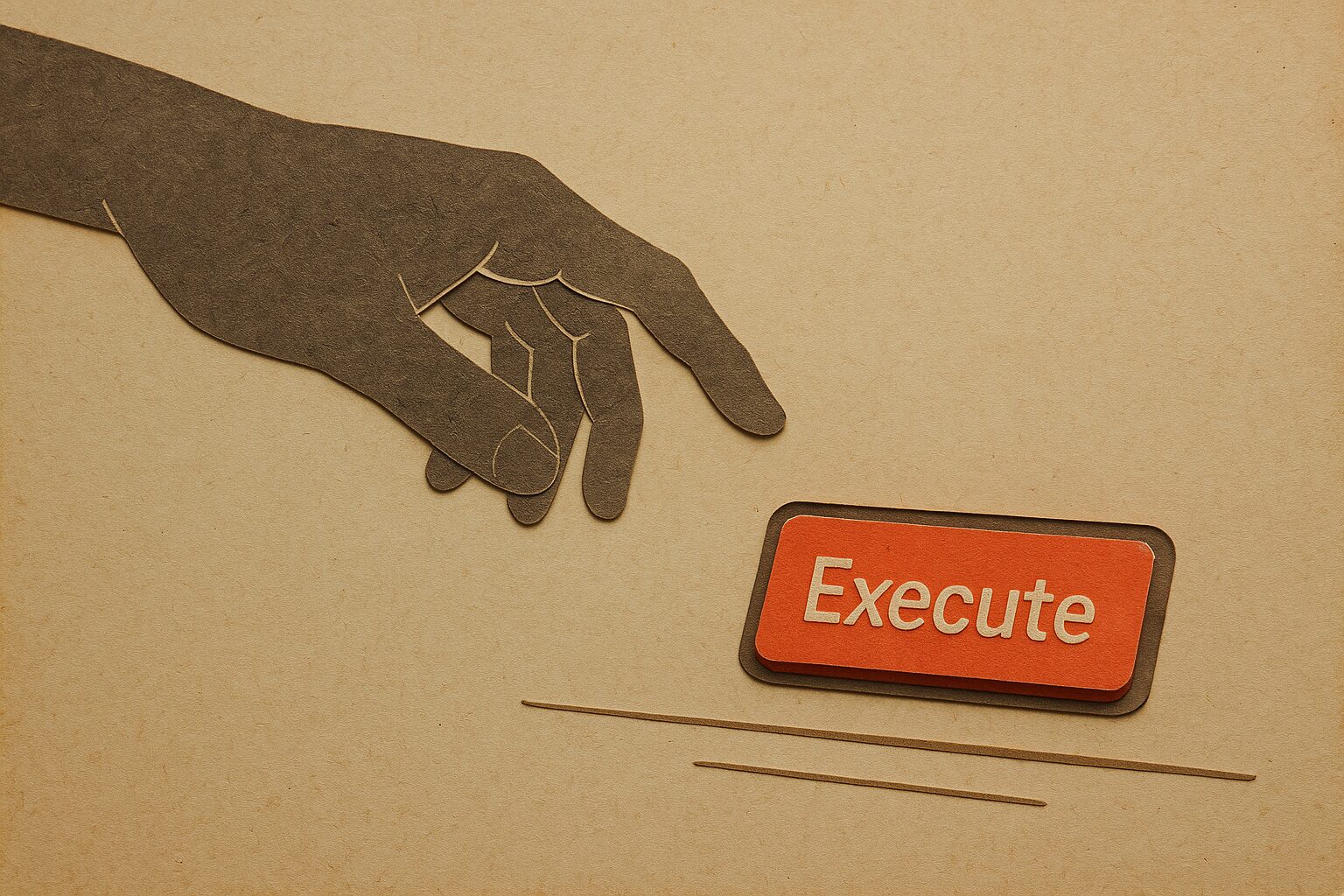
There’s a growing trend in AI-driven products that encourages users to delegate tasks entirely, from drafting critical emails to applying for jobs, without meaningful human oversight. While automation once held the noble promise of removing repetitive and mundane tasks, we’re now facing a shift into deeper waters, where tasks inherently requiring subtlety, judgment, and genuine intention are also casually handed off to machines.
When automation becomes absurd
I recently watched a product demo that perfectly captures this drift. The presenter casually instructed their AI agent to “send to LeBron James a poem about Paris saying that the city is so good that he should come play here in Paris“. This wasn’t a joke or edge case testing. It was presented as a normal use case alongside drafting emails and finding job listings.
This kind of scenario feels less like thoughtful delegation and more like automation for automation’s sake. It’s naively optimistic, detached from practicality, and oddly indifferent to actual intent or outcomes. More importantly, it reveals something troubling about how these tools are being positioned and used.
From unintended to unthought consequences
It’s within this space that a crucial distinction emerges. Previously, discussions around automation revolved around “unintended consequences“. We acknowledged that despite our thoughtful intentions, technology can yield surprising or undesirable results. We planned for X, but got Y instead.
Yet today, we’re stepping into a far murkier area: unthought consequences. These are outcomes born not from a careful intention that went awry, but from a willingness to remove intention and thought from the equation altogether. We’re not even planning for X. We’re just hitting “execute” and walking away.
The slippery slope of convenience
The problem isn’t that these tools are designed to rob us of our intent. It’s more subtle than that. Just as TikTok doesn’t force you to doom-scroll for an hour, but you find yourself doing it nonetheless, automation tools create a path of least resistance that’s hard to resist over time.
You start by automating genuinely mundane tasks. Scheduling meetings, formatting documents, organizing files. This makes sense. It frees up mental energy for more important work.
But gradually, the definition of “mundane” expands. Email responses that used to require thought become templates. Job applications that used to be carefully crafted become bulk operations. Creative tasks that used to express personality become algorithmic outputs.
The motivation behind such designs often stems from the startup culture’s obsession with hyper-efficiency and frictionless experiences. There’s a genuine drive among young entrepreneurs to “hit FU money” or “get to a liquidity event” that leads to building products optimized for volume over quality, speed over thoughtfulness.
The recursive trap
This leads us inevitably to a troubling question: what precisely are we freeing ourselves up for? The promise of saved time via automation is increasingly hollow when much of this freed capacity ends up reinvested into automating yet more tasks. It’s a recursive loop of efficiency without purpose, driving us toward an eventual landscape of thoughtless automation.
We automate email responses to have more time for strategic thinking. Then we automate the strategic thinking. We automate job applications to apply to more positions. Then we automate the interview preparation. Each step feels logical in isolation, but the cumulative effect is a gradual abdication of the judgment and intentionality that made the original work meaningful.
The contamination risk
The real danger isn’t that people will suddenly start delegating everything to AI. It’s that the boundary between appropriate and inappropriate automation will gradually erode. Tasks that genuinely don’t require human intention get mixed up with tasks that absolutely do, and we lose the ability to distinguish between them.
When you’re used to automating scheduling and formatting, automating a heartfelt message starts to feel like a natural next step. When you’re used to AI generating first drafts, letting it generate final drafts doesn’t seem like such a big leap. The easy way out becomes the default way out.
What we’re actually choosing
But here’s my doubt about this trajectory: Will people genuinely embrace this vision of frictionless productivity? Do we seriously expect thoughtful professionals or creative individuals to delegate meaningful communication to an indifferent AI? Or is this another Silicon Valley fantasy that underestimates the very human need for intent, accountability, and genuine connection?
I suspect most people, when confronted with the actual choice, will resist the more absurd applications of automation. The LeBron James poem feels ridiculous because it is ridiculous. But the challenge is that we won’t always be confronted with such clear choices. The drift toward thoughtless automation happens gradually, one small convenience at a time.
Designing for intention
The challenge ahead is clear: we must actively resist the seduction of “unthinking convenience“. Automation isn’t inherently problematic, but automating thoughtlessly and carelessly, blindly generating unthought consequences, certainly is.
Instead, thoughtful design must prioritize human intention, accountability, and meaningful engagement over superficial convenience and empty efficiency. This means building tools that enhance human judgment rather than replacing it, that make the important choices more visible rather than hiding them behind automation.
Intent isn’t merely a luxury. It’s the essence of meaningful human action. And in an age where machines can simulate almost any output, the presence or absence of genuine human intention becomes the most important distinction of all.
Leave a Reply
You must be logged in to post a comment.