
By the early 2010s, something began to change. Quietly at first, almost imperceptibly. Global test scores in reading, math, and science, especially among teenagers, started to slide. Not as a momentary dip, but as a steady, measurable trend playing out across developed nations (OECD PISA 2023). At the same time, computing power kept accelerating. Our phones became permanent fixtures in our hands. Internet traffic skyrocketed (Cisco Annual Internet Report). Bandwidth, once reserved for entire countries, became personal. We became faster. More connected. And somehow, infinitely more scattered.
Are we migrating, or are we breaking?
It’s easy to tell ourselves we’re just shifting cognition. We used to do math in our heads. Now we use spreadsheets. We once memorized routes and landmarks. Now we follow GPS. Our thinking hasn’t disappeared. It’s just changed form, outsourced to tools we’ve come to trust. That’s one way to see it. But maybe it’s too neat.
When you zoom out, other explanations emerge, ones that feel heavier. The financial crisis of 2008 and its long shadow. The erosion of public infrastructure. Changes in parenting, education, social norms. A mental health landscape that’s shifting under our feet. These are not footnotes. They’re the backdrop. And while technology might not be the villain of this story, it certainly isn’t blameless. Especially when it’s optimized not to help us, but to hold us.
This isn’t about decline, at least not in the nostalgic sense. It’s more a question. Are we offloading our thinking because it helps us focus on what matters, or because it’s easier to give in to convenience and habit?
The thermodynamics of thinking
Let’s be honest. No one was seriously trying to apply Landauer’s Principle or the Bekenstein Bound to human behavior (in theoretical physics, the Bekenstein Bound places a hard cap on the amount of information that can be stored in a finite region of space). These weren’t scientific claims. They were metaphors. Attempts to name something more emotional than empirical: the weight of too many tabs open in the mind, the slow erosion of focus, the fatigue of constant switching.
We’re not building digital minds. We’re bending our behavior to match systems that reward quick taps and instant replies. The brain that once took time to write carefully now pushes out fragments into a feed. That change matters. It shifts what we value, how we learn, even what we remember.
Design is not neutral
If you work in UX, you’ve probably heard of captology, the study of how technology persuades behavior. That field has quietly grown into something much larger, something closer to environmental design. And yet, most people haven’t really stopped to ask what happens when we build systems that don’t just guide behavior, but reshape it at scale.
We keep optimizing for engagement, treating it like a measure of value. But we know that’s not true. Not all engagement is good. A calculator supports thinking. Infinite scroll undermines it. One helps you process. The other drains you. We’ve been treating all digital interactions like they’re interchangeable. They’re not. GPS and doomscrolling don’t belong in the same category. Offloading your brain isn’t always bad, but doing it without intention carries real risk.
So here’s the question I keep coming back to. When do we start slowing down? When do we design not for maximum interaction, but for minimal cognitive harm?
Because if I look around at education, at attention spans, at how we talk and think, I get the sense we’ve gone too far. We design like we’re in a race, one where every second spent in-app is a victory. But if we zoom out, the race starts to look more like a stampede. Toward a cliff. And right now, it feels like designers are sprinting with the crowd, not asking where we’re all headed.
What comes after the cliff?
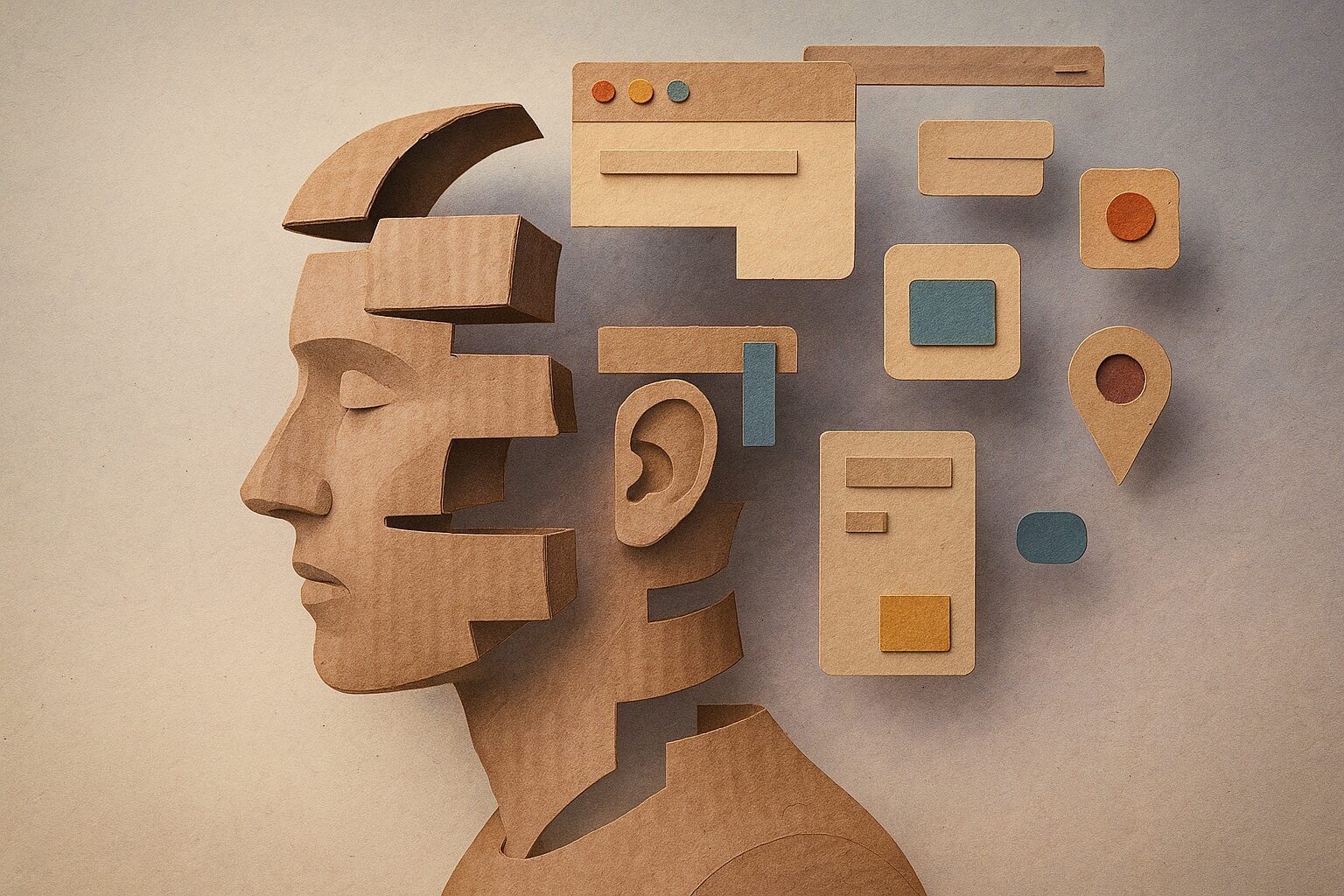
Maybe cognition hasn’t escaped the skull. Maybe it’s simply scattered—fragmented across feeds, offloaded into apps, stretched thin between dopamine loops. Maybe this isn’t a computational migration, but a cognitive diaspora.
But it’s not irreversible. Designers still hold a kind of power. Not to rebuild cognition from scratch, but to shape the spaces where thought can breathe. To make interfaces that protect attention instead of mining it. To slow things down just enough for people to ask themselves, Is this actually helping me?
We don’t have to design the next leap in intelligence. Maybe we just need to stop designing ourselves out of it.